
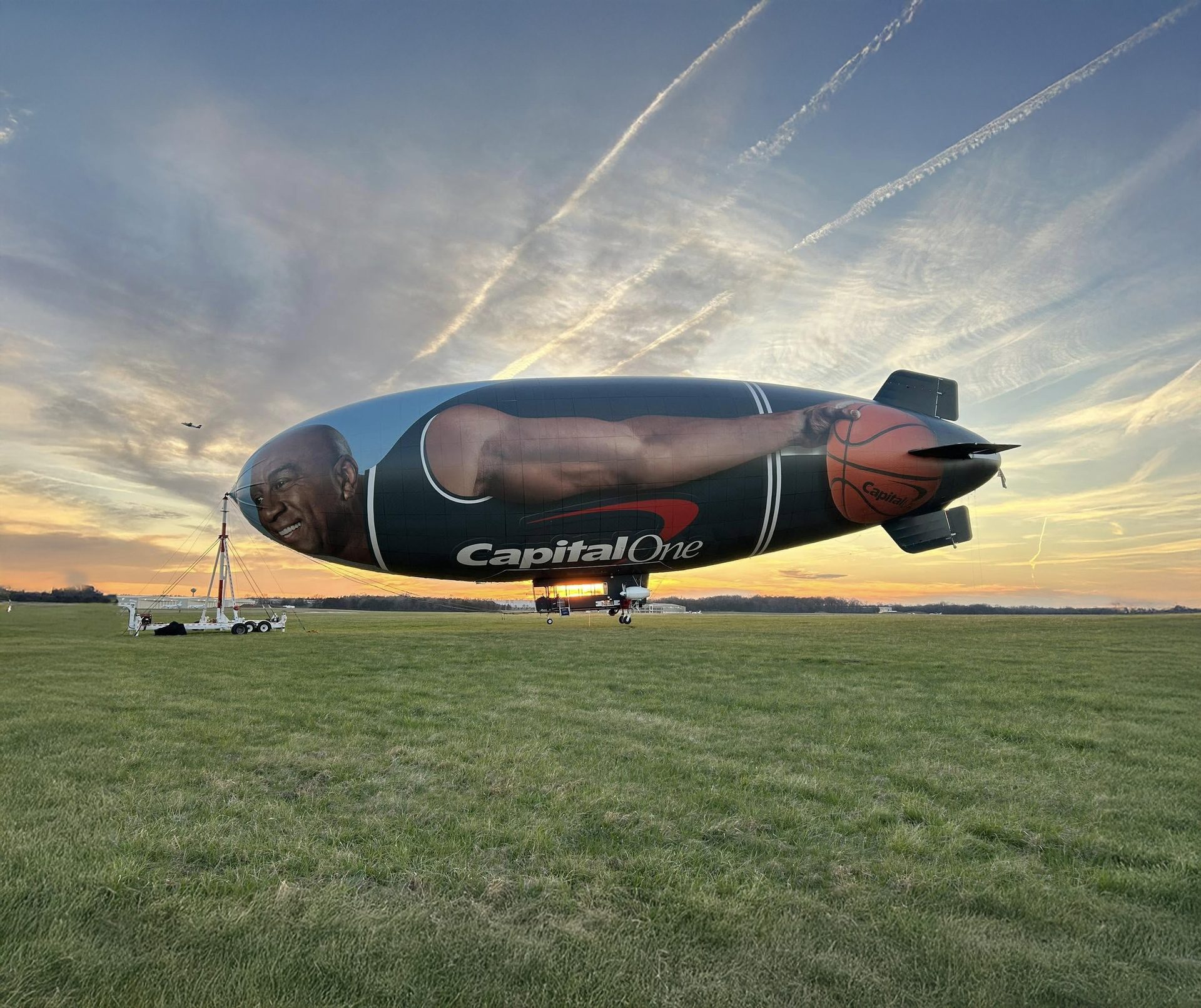
Here's a question worth sitting with. When a hundred thousand basketball fans descend on one city for the loudest weekend of the season, where does everybody eventually look? Up. They always look up.
That single, stubborn fact is the reason we put not one, but two custom airships over San Antonio in the run-up to the Final Four — and why Capital One's March Madness campaign is still one of our favorite stories to tell.
Let's set the scene. March Madness isn't just a tournament. It's a stampede. Every brand on earth wants a piece of it, which means every screen, every timeout, every commercial break is a bidding war of shouting. And here's the thing about a room where everyone is shouting: nobody gets heard. You just get a headache.
Capital One didn't want to shout louder. They wanted to be seen. There's a difference, and it's a big one.
So we flew. We wrapped two of our airships head to toe in Capital One's colors, put basketball royalty front and center — Charles Barkley and Magic Johnson, names that need no introduction to a Final Four crowd — and floated them over the host city for days. Not thirty seconds. Days.
The math nobody talks about
A commercial gets six seconds before a thumb finds the skip button, or the length of a bathroom break before tip-off. An airship over a championship city? It hangs there. All morning. All afternoon. Through the pre-game tailgates and the post-game celebrations and every selfie in between.
And that's where it gets fun. Because a blimp over San Antonio isn't an ad people tolerate — it's a thing people photograph. Fans looked up, saw two Capital One airships gliding over the skyline, and did what humans do now: they pulled out their phones. Every one of those posts was a tiny, free, enthusiastic ad, made by the exact people the brand was trying to reach.
You cannot buy that kind of momentum. You can only earn it — by being the most extraordinary thing in the sky.
Why it worked
The genius of the play wasn't the size of the ships, though they were plenty big. It was the timing and the place. We didn't fly over an empty field. We flew over a captive, buzzing, camera-ready crowd who had already decided this was the best weekend of the year — and we handed them a Capital One moment they were thrilled to share.
That's the quiet magic of aerial advertising. It doesn't interrupt the moment. It becomes part of it. While competitors were paying a fortune to squeeze into the gaps between plays, Capital One owned the one piece of real estate nobody else thought to buy: the sky above the whole thing.
And here's the part worth stealing for your own brand: this wasn't a gamble on going viral. It was engineered. Pick the moment your audience already cares about, put something unmissable in the sky above it, and let a hundred thousand cameras handle the distribution. Capital One didn't hope people would notice — they made noticing the easiest, most natural thing in the world. That's the difference between renting attention and owning it: a screen ad borrows a few distracted seconds, while an airship over a championship city commands the undivided gaze of a whole crowd already having the best day of their year.
Be seen, not skipped.
A billboard waits for you to drive past. A pre-roll waits to be skipped. An airship hangs over the moment for hours — unmissable, unskippable, endlessly shareable. It doesn't interrupt the event. It is the event.
Now picture your brand up there. That's what an airship does — it launches you sky-high: millions of impressions, viral by nature, impossible to scroll past. Not an ad people tolerate — a moment they can't stop sharing. And Skyship Services owns and operates the fleet, so one team takes you from the first call to the final flight.